
• Skip to primary navigation
  • Skip to main content
  • Skip to primary sidebar
  • Skip to footer

Forward Focus

Assisting Small Businesses

  • HOME
  • SERVICES
    • PRACTICE FORWARD
    • BUSINESS SERVICES
    • TAX SERVICES
    • IRS REPRESENTATION
    • CFO SERVICES
  • RESOURCES
  • ABOUT
  • BLOG
  • Newsletter
  • CONTACT
  • Search

BLOG

Jul 03

CLAIMING DEPENDENTS AFTER DIVORCE

CUSTODIAL VS. NONCUSTODIAL PARENTS

Glen and Gail Newsome have divorced this year. Their 14-year-old child, Dawn, lives with Gail for a majority of the year and with Glen from mid-June
through August. Glen and Gail each provide half of
Dawn’s support. The divorce decree specifies that Glen can claim Dawn as a dependent in odd-numbered
years, and Gail can claim Dawn as a dependent in
even-numbered years. In the odd-numbered years, Gail signs Form 8332 to release claiming Dawn as a
depen
dent to Glen.

Gail can file as head of household (HOH) because she paid more than half the cost of maintaining her home, which is also Dawn’s home for the majority of
the year. Even though Gail released her claim to the
child as a dependent to Glen, it does not affect her
ability to claim HOH status.

Regardless of whether the custodial parent releases the exemption, both parents are eligible for itemized medical expenses and tax-free health savings account
(HSA) distributions.

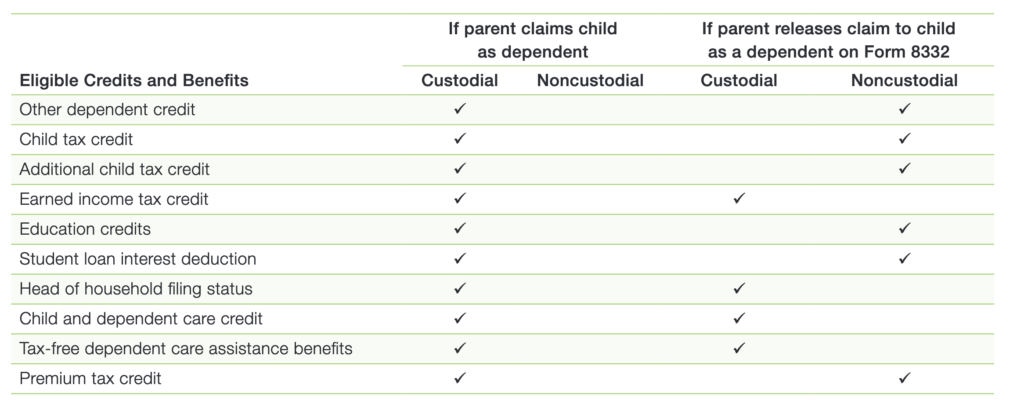
The chart below summarizes which benefit each parent receives when the custodial parent releases the dependency to the noncustodial parent. If the custodial
p
arent did not release the dependency exemption, the custodial parent would receive all the benefits, and the noncustodial parent wouldn’t receive any.

In addition, the child is the dependent of both parents for purposes of the medical expense deduction rules, regardless of whether the custodial parent
releases the claim to the child as a dependent, if the
taxpayers are both of the following:

• Divorced, legally separated under a decree of divorce or separate maintenance, legally separated under a written separation agreement or lived
apart at all times for the last six months of the
calendar year.
•
Parents of a child who meets the following provisions: (1) receives more than half of their support during the calendar year from their parents; (2) is in the custody of one or both parents for more than half of the calendar year, and (3) qualifies as a qualifying child or qualifying relative of one of the child’s parents (Rev. Proc. 2008-48)

Medical expenses covered under this provision include medical expense reimbursements or deductions, excludable fringe benefits, and distributions from an HSA or Archer MSA.

Jul 03

CONSEQUENCES OF NOT FILING TAXES

Taxes are typically a simple sequence of filing a tax return, paying the balance due or receiving a refund. One of our primary responsibilities as tax professionals is to keep the client in perpetual compliance. Knowing IRS due dates is crucial to guiding our clients to file timely. If a taxpayer is found to have willfully neglected to
file a return, the IRS can review their entire tax history
for fraud. This potentially creates more stress since the period for fraudulent review is typically three years.

Penalties and interest Non-compliance is costly. The IRS assesses multiple penalties that layer on top of each other. In addition, interest is charged on unpaid balances. Tax preparers often charge more for filing pastdue tax returns. Not to mention, there may be additional administrative fees to catch up on prior-year bookkeeping.

Once the filing deadline passes, the IRS will mail the taxpayer a letter notifying them of a failure to file penalty. The penalty is calculated on two factors: how
late the return is and the amount of unpaid tax. The
IRS bases the timeliness of a return on the original due date, not the extension due date. The IRS calculates
unpaid tax based on information it knows, reported
under the taxpayer’s SSN. The IRS looks at the total tax on the tax return, less any withholding, estimated
payments and allowed refundable credits.

According to the IRS:

• The failure-to-file penalty is 5% of the unpaid taxes for each month or part of a month that a tax return is late. The penalty won’t exceed 25% of the
unpaid taxes.

•
If both a failuretofile penalty and a failureto pay penalty are applied in the same month, the failure-to-file penalty is reduced by the amount of the failure to pay penalty for that month for a combined penalty of 5% for each month or part of a month that the return was late.
•
If after five months the taxpayer still hasn’t paid, the failure to file penalty will max out, but the failure-to-pay penalty continues until the tax is paid, up to 25% of the unpaid tax as of the due date.
•
If the return was over 60 days late, the minimum failure to file penalty is $435 (for tax returns required to be filed in 2020, 2021 and 2022) or 100% of the tax required to be shown on the return, whichever is less.

Collections

The IRS issues bills for amounts due. It will send at least one reminder. Of course, taxpayers have the right to disagree with any information on the bill. The IRS
provides guidance on how to dispute charges on the
bill itself. If taxpayers do not pay, or do not establish payment arrangements, the collection process begins.

The IRS collection process includes liens and levies. A lien is a legal claim against all the taxpayer’s current and future property. A levy is the actual seizure
of property. The IRS cannot seize property if the
taxpayer is in good standing with (or has a pending) installment agreement or offer in compromise, or if it
determines there’s an economic hardship.

Other IRS violations

  • Submitting fraudulent returns
  • Tax evasion
  • Making fraudulent and false statements
  • Identity theft
  • Nonsufficient funds

Conclusion

There are many steps and opportunities to rectify tax situations. The IRS offers online tax tools like the Interactive Tax Assistant and the Earned Income
Tax Assistant. Plus, taxpayers can always view their
tax accounts on IRS.gov.

Feb 03

Don’t Fall for a Scam

How the IRS Contacts Taxpayers

Tax preparers should educate their clients on how the IRS communicates with them so they can recognize a scam when they see it. Initial contact from the IRS is normally by letter
or written notice delivered by the U.S. Postal Service to a taxpayer. However, depending on the situation, IRS employees may first call or visit with a taxpayer.

In some of these instances, the IRS will send a letter or written notice to a taxpayer in advance, but not always. Taxpayers can search IRS notices by visiting Understanding Your IRS Notice or Letter on IRS.gov. Not all IRS notices are searchable on the site, and just
because someone references an IRS notice in an email, phone call, text or social media doesn’t mean the request is legitimate.

After mailing a notice, an IRS revenue agent or tax compliance officer may call a taxpayer or tax professional to confirm an appointment or to discuss items for a scheduled audit. IRS revenue officers and agents routinely make unannounced visits to a taxpayer’s home or place of business to discuss taxes owed, delinquent tax returns or a business falling behind on payroll tax deposits. IRS revenue officers will request payment of taxes owed by the taxpayer. However, taxpayers should remember that payment will never be requested to a source other than the U.S. Treasury.

When visited by someone from the IRS, taxpayers should always ask for credentials. IRS representatives can always provide two forms of official credentials: a pocket commission and a Personal Identity Verification Credential.
The IRS doesn’t normally initiate contact with taxpayers by email. Do not reply to an email from someone who claims to be from the IRS because the IRS email address could be spoofed or fake. Emails from IRS employees will end in IRS.gov. IRS agents do not send text messages or contact people through social media. Fraudsters will impersonate legitimate government agents and agencies on social media and try to initiate contact with taxpayers.
Private debt collectors can call taxpayers for the collection of certain outstanding inactive tax liabilities, but only after the taxpayer and their representative have received written notice. Private debt collection should not be confused with debt relief firms who will call, send lien notices via U.S. mail or email taxpayers with debt relief offers. Taxpayers should contact the
IRS regarding filing back taxes properly. For more information, visit:
www.irs.gov/newsroom/taxpayers-can-protect-themselves-from-scammers-by-knowing-how-the-irs-communicates


Feb 03

Working From Home

Working from home meeting

Schedule C depreciation expense deduction recalculated

Operating a Schedule C business offers some tax benefits when it comes to deducting expenses normally considered personal. It can provide an exception for deducting personal living expenses of a taxpayer’s home as long as it is the taxpayer’s principal place of business and used to meet customers, clients or patients dealing with the taxpayer’s normal course of business.

Depreciation is allowed or allowable for business-use property (i.e., the normal wear and tear of such property placed in service). To claim depreciation, taxpayers must establish a cost basis. The allocation should be based on the percentage or square footage that pertains to the business use. The allocation should be reasonable and supported. When a personal residence is used for business, the depreciable basis is the lesser of the adjusted basis, including improvements or the fair market value (FMV) on the date of conversion.

For Rodrigo and Loreta Kho, the square footage and percentage of cost basis allocated toward depreciation was questioned. The IRS redetermined the correct allocation based on submitted documentation. The couple, who provides foster care to two adult individuals, could not support their original allocation for the business use of their home. They filed Schedule C for 2012 and 2013, with a depreciation deduction of $7,465 and $7,788. They were able to support the claim of two bedrooms and an additional bathroom used exclusively and regularly in their foster care business. The taxpayers provided support for renovations done in 2008 for the additional rooms at a cost of $125,000. From documentation submitted during the review process, the additions represented 70% of the total square footage added during the renovations, or 402.5 total square feet. The total square footage of the home was approximately 1,665
square feet, which meant the business use was about 25% of the total home. There is an allowed deduction as a reasonable allowance for the exhaustion and wear and tear of property used in a trade or business. Basis for this depreciation deduction is the cost of the property.

Mar 19

Who Can Help Me with my 2020 Tax Debt?

If you have tax debt and wonder how you’ll manage to pay them in 2021, you’re not alone.

At the end of 2019, there were 25 million taxpayers who also wondered how they’d pay their taxes—even before the pandemic made life more challenging.

On a positive note, the IRS is aware of the situation and has created new procedures to provide relief to taxpayers while helping them meet tax requirements. Here are a few tips:

More Time to Pay 2020 Tax Debt

For taxpayers who can pay but simply need time, there are some nice changes the IRS has made to its normal collection procedures. These include:
• Increase the length of short¬-term payment plans from 120 days to 180 days.
• Allow taxpayers additional time to make payments on an accepted offer in compromise.
• Automatically add certain new tax balances to existing installment agreements for individual and out¬-of-¬business taxpayers instead of defaulting the agreement.
• Allow individual taxpayers assigned to campus collections who owe less than $250,000 to set up installment agreements without providing a financial statement.
• Allow some individual taxpayers who owe less than $250,000 to qualify for an installment agreement without a notice of federal tax lien filed by the IRS.
• Enable qualified taxpayers with existing direct debit installment agreements to use the online payment agreement system to propose lower monthly payments and change their payment due dates.
What do these changes mean and which strategies should you consider when addressing your tax debt? You have some options.

The $250,000 Streamlined Tax Debt Payment Installment Agreement

It’s not a secret. The IRS wants its money as quickly as possible. They’ll seek to have taxpayers liquidate investments and retirement accounts and even tap equity in their home. By utilizing the procedures below, you can avoid that and get into a payment plan to resolve your tax issue.

The IRS has always had a streamlined installment agreement available for qualified taxpayers. Basically, a streamlined installment agreement is an agreement with the IRS to repay the debt within the terms laid out. If the taxpayer qualifies and can meet the terms, the taxpayer won’t have to submit a financial form (Collection Information Statement) and disclose assets and income.

These agreements are beneficial because, aside from avoiding disclosing assets and income, the taxpayer doesn’t need to spend money on a professional to complete the forms and begin negotiating with the IRS. The agreement can be put in place with a simple phone call or by going online and setting it up through the IRS portal.

Streamlined agreements have changed over time. Due to the sheer number of taxpayers the IRS believes will need help due to COVID¬19, they have made these agreements easier than ever.

Tax Debt Relief: Offer in Compromise (OIC) Payments

The IRS OIC program generally allows for two types of offers: a lump-sum offer and a short-term deferred offer. A lump sum offer is one in which the taxpayer agrees to pay the offered amount within five months of the date of acceptance.

A short-term deferred offer, also known as a “periodic payment offer,” has the taxpayer making monthly payments while the offer is pending. They then will pay the balance of the offer in more than six months (but not more than 24 months).

The short-term deferred offer operates the same as a lump sum offer. The exception is the taxpayer must begin making monthly payments and continue making them while the offer is being con¬sidered, just like an installment agreement. Any hardship caused by COVID19 may also be considered to grant additional time.

Strategies to Tackle Tax Debt in 2021
Some strategies can be employed to get the best result for our clients. For instance, assume we have a client who owes $300,000 for 2020. The taxpayer has an IRA with $150,000 and a home with no mortgage worth $450,000. The taxpayer’s income and expenses show an ability to make payments of $5,000 a month. Our client, though, doesn’t want to make payments at that rate because, economically, it would make life a bit rough.

The taxpayer could do the following:
• Call and set up a short-¬term (six month) payment plan to pay the balance. Once that’s set up, they could make six payments of $5,000 each. After the six months, they now owe $270,000.
• Call automated collections, explain they could not raise all the money, but ask for first-time penalty abatement. This would remove 1/2 % a month for eight months (from April 2020 – December 2020) for the failure to pay penalty, or 4%. The reduction of the 4% from the $300,000 would remove approximately $12,000 of accumulated penalty, reducing the liability to $258,000.
• Get a home equity line and use $10,000 from that to reduce the liability below $250,000.
• Create a streamlined installment agreement (below $250,000 over the time remaining on the collection statute, which is approximately 114 months). The monthly payment should be around $2,300 a month, and they won’t have to liquidate their IRA or get stuck paying $5,000 a month for five to six years.
These numbers are rough, but hopefully they demonstrate that you can be creative and combine some of these options to reach a solution that works to your advantage—or is easier to swallow than the IRS’s straight analysis.

Here, we can decrease penalties, use the short¬-term payment plan to buy time and pay down below the $250,000 streamlined cutoff to avoid the disclosures and get into an affordable monthly payment plan.

Each client’s situation is unique. Understanding the rules is the first step to mastering the game, and it’s a game that is interesting, challenging and potentially extremely profitable to those of us who handle IRS representation matters.

If you would like to learn how these strategies could apply to your current situation, please give us a call and we’ll be happy to help. With some planning and guidance, your tax debt could become a lot more manageable. Contact us at 614-802-6950 for more information.

Feb 19

Which Accountant is Right for You: CPA, EA, or Paid Preparer

Tax season is here! If you’re wondering where to turn to get the best service for your tax return and avoid the headaches of doing it yourself, then this article will be the most important message you’ll read today.

There are many professional accounting services that can help you with your taxes, but which one should you choose? How do you know they’re right for you?

First, let’s define the different types of professional accountants: the CPA, the EA, and the Paid Preparer. We’ll take a closer look at each one:

Accountant Professional #1: The Certified Public Accountant (CPA)
A certified public accountant (CPA) is a designation given by the American Institute of Certified Public Accountants (AICPA) to individuals that pass the Uniform CPA Examination and meet the education and experience requirements. The CPA designation helps enforce professional standards in the accounting industry.

Traditionally a CPA was required to have a bachelor’s degree in business administration, finance, or accounting to be able to sit for the exam. Currently the academic requirements to sit for the CPA exam are 150 semester college credits of which 30 of those credits must be in accounting courses and 24 credits in business courses.  Additionally, they must complete approximately 40 hours of continuing education each year and have no fewer than two years of public accounting experience.

CPAs often work within companies and can move into executive positions such as controllers or chief financial officers.

Accountant Professional #2: The Enrolled Agent (EA)
An enrolled agent (EA) is a tax professional authorized by the United States government to represent taxpayers in matters regarding the Internal Revenue Service (IRS). EAs must pass an examination or have sufficient experience as an IRS employee and pass a background check. They are also required to complete approximately 26 hours of continuing education each year.

Enrolled Agents advise, represent, and prepare a tax return for individuals, businesses, and any entities with tax-reporting requirements. An EA’s expertise in the ever-changing world of taxation allows them to effectively represent taxpayers audited by the IRS.

Like CPAs, Enrolled Agents have virtually unlimited practice rights before the IRS, meaning there are no restrictions to the types of tax issues they can handle and the type of taxpayers they can serve.

Enrolled agents are required to prove their proficiency in every aspect of taxes, ethics, and representation. Unlike CPAs and attorneys, the Enrolled Agent specializes in all tax matters whereas the CPAs may specialize in many different areas. An EA is typically significantly lower in cost than a CPA.

Accountant Professional #3: The Paid Preparer
A tax preparer is a professional that is qualified to calculate, file and sign income tax returns on behalf of individuals and businesses. They can also represent the taxpayer during IRS examinations of tax returns. There are various types of job titles these professionals may have, as well as various certifications and educational levels; individuals need to choose which type of tax professional will best suit their situation.

Common businesses that are paid preparers include H&R Block, Liberty Tax, and Jackson Hewitt. Paid preparers receive some training, but their knowledge and experience could be at any level. Many of them do it as a second job and for only four months out of the year. This type of professional may overlook some of the deductions you could receive when preparing your tax return.

Making Your Decision
Regarding which to choose is dependent upon the complexity of your needs and cost. However, for most individuals and small businesses, hiring an EA to address their tax preparation needs is more than adequate and cost-effective.


  • Page 1
  • Page 2
  • Go to Next Page »

sidebar

Blog Sidebar

Categories

  • accounting
  • Practice Forward
  • retirement
  • small business
  • taxes
  • Uncategorized

Recent Posts

Jul 03

CLAIMING DEPENDENTS AFTER DIVORCE

Jul 03

CONSEQUENCES OF NOT FILING TAXES

Feb 03

Don’t Fall for a Scam

Footer

Contact Us

  • This field is for validation purposes and should be left unchanged.
  • Fields marked with an * are required.

Recent News

CLAIMING DEPENDENTS AFTER DIVORCE

CUSTODIAL VS. NONCUSTODIAL PARENTS Glen and Gail Newsome have divorced this year. Their Read More

CONSEQUENCES OF NOT FILING TAXES

Taxes are typically a simple sequence of filing a tax return, paying the balance due or receiving a Read More

  • Facebook
  • LinkedIn

3518 Riverside Dr. Suite 207 | Upper Arlington, OH 43221
614.802.6950

© 2026 Forward Focus Accounting

TAX AND BUSINESS SUPPORT SERVICES FOR
INDIVIDUALS AND SMALL BUSINESSES
• Payroll
• Bookkeeping & Accounting
• General consulting and CFO services
• New business consulting & setup
• Preparation of business & personal tax return